Pinned mechanics implementation and CPU numerical benchmark
Hardware matched robot simulation
Pinned CPU mechanics · PiPER contact pilot · physical fidelity unmeasured
Abstract
A separate UR5e/Robotiq reference preserves pinned geometry, inertias, moving-link collision proxies and coupled gripper structure: fourteen modeled coordinates and seven commands. Eighteen deterministic unloaded motion/closure runs are numerically valid; at a 1 ms step, CPU physics throughput measures 40.80–47.29 simulated seconds per measured stepping wall second on one host, excluding loading, sensing, rendering, policy and real actuation. Adjacent timestep comparisons and a matched static overlap expose numerical sensitivity and collision participation. A pure-Python paired trace scorer measures joint, tool and jaw mismatch without automatic qualification. Left/right five-finger references are separately audited; LeRobot collection with an original DVIDIA policy is proposed. Serial calibration, physical response, shoe task learning and bimanual execution remain unmeasured. An offline 3D mesh replay now exposes the recorded arm/gripper poses without rerunning physics. PiPER and SO-101 now have pinned CPU profiles with 6/6 valid unloaded numerical attempts each and explicit native command units. PiPER also has a frozen authored rigid-block contact pilot: nominal placement 2/2, low-friction placement 0/1, open-jaw 0/3 and hold 0/3, with all nine attempts numerically valid. One of 9,000 computation windows exceeds 20 ms; hardware real-time response is unqualified. SO-101 object tasks, learned policies and physical qualification remain open. YAM, OpenArm, ARX X5 and PAROL6 remain upcoming.
In this paper
DVIDIA research · 11 October 2026 · Compiled reference assembly and unloaded CPU diagnostics; physical transfer unmeasured
Build the first simulator around a specific six-axis arm and gripper, then measure the physical response that the learner will encounter. DVIDIA's vision remains a Skillspace that supplies demonstrations, local training and an installable skill. Rendered images support visual learning, but matching a room's appearance and the arm's number of joints does not establish that a learned action will produce the same motion, grip or outcome on hardware. We have compiled a pinned UR5e and Robotiq 2F-85 reference and run eighteen unloaded CPU diagnostics; this does not select the user's eventual purchase or reproduce that robot's controller. Later, two arms with five-finger hands need a different command, sensing and contact contract. Imported structure, numerical characterization and held-out physical agreement remain separate evidence states. Useful speed is the cost of acquiring a qualified capability, measured alongside errors and failures.
Six arm joints do not specify the whole robot
DVIDIA's existing dvidia-authored-6dof-parallel-jaw-v0 environment is an authored rigid-box contact experiment. It has six arm hinges, two simulated sliding jaws and eight native position actuators, exposed through six joint targets and one total-gap target. Arm links, base and palm have collision masks disabled; the experiment therefore does not evaluate whole-arm avoidance or self-collision. Exact object state, contact counts and pad forces are native simulator observations, not measured camera or fingertip signals. Preserve this profile and its frozen results while adding a separately named hardware reference. (Current arm source)
The UR5e is a suitable six-axis software reference. Its manufacturer lists six rotating joints, 850 mm reach and 5 kg payload. Those specifications describe hardware capability; the listed 0.03 mm repeatability does not mean that a generic simulator predicts tool position to 0.03 mm. Menagerie's UR5e derives from a URDF, uses simplified collision shapes and adds position actuators. It supplies a reproducible mechanical description rather than the proprietary controller's complete response. (UR5e specifications, Pinned model derivation)
The new reference attaches the gripper through MuJoCo's spec interface with a stable prefix and the upstream attachment transform. The pinned original 2F-85 model has eight linkage hinges, a split tendon and loop-closing constraints, driven by one actuator with a 0–255 command range. The compiled assembly confirms fourteen position coordinates, fourteen velocity coordinates and seven actuator channels, with three equality objects and one tendon. Gripper coordinates are coupled linkage motion, not eight independent finger commands. A requested physical jaw gap requires a calibrated conversion, and the model's tendon force limit is not the physical gripper's fingertip force setting. (MuJoCo attachment API, Pinned arm XML, Pinned gripper XML, DVIDIA reference tools)
The assembly has 24 active collision geoms. Each of its six moving arm links has a collision proxy; the fixed base has none, and exclusions/filtering still affect self-contact. It has zero native sensor channels. Recorded poses, velocities and contact counts are privileged simulator state. This structural improvement over the authored box experiment does not establish complete collision geometry, physical sensing or a shoe task. (Reference audit receipt)
Pin the asset revision 0059d4335f8156206f63a35662313385f7ad6d74, model and mesh hashes, derivation notes and per-directory licenses. The arm's BSD-3-Clause and gripper's BSD-2-Clause notices accompany any redistributed assets; DVIDIA's original MIT software license does not replace them. A cached dependency bundle supports local operation after provisioning. Downloading the bundle is a separate setup step. (Pinned revision, Arm license, Gripper license)
Inspect the arm and gripper in three dimensions
Open the interactive 3D replay. The original numerical report draws a flat projection of recorded link centers. The native physics already simulates three-dimensional positions, orientations and contact geometry; six arm DOFs mean six rotating joints. The new replay renders the actual compiled arm/gripper meshes and collision proxies, with orbit/zoom controls, preset views, six-joint readouts and a recorded timeline.
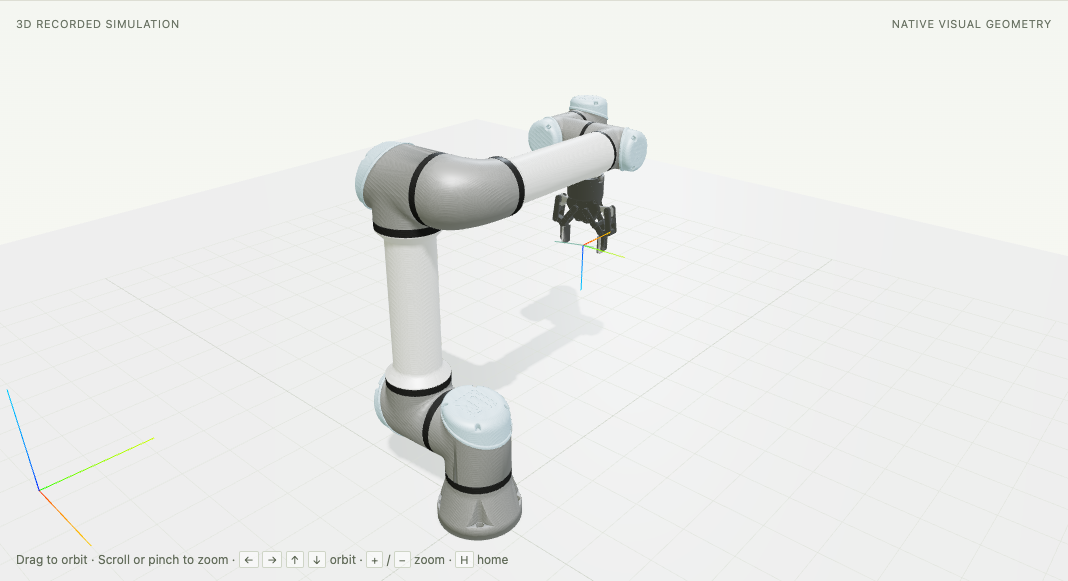
The native mesh replay at 1.10 seconds in the recorded arm sweep. Eight browser acceptance groups passed across desktop, phone and landscape layouts; this is display validation, not physical-fidelity or rendering-speed evidence. Browser checks.
The exporter verifies the frozen receipt and pinned assets, reconstructs recorded arm/linkage poses with native forward kinematics and checks tool/pad/link-center agreement before writing display transforms. It does not step physics or rerun the benchmark. Mesh vertices and transforms use float32 display storage; exact repeated vertices are deduplicated without changing triangle coordinates. Original numerical files remain unchanged and downloadable under the replay's receipt/ directory. The viewer is bundled locally with retained asset and Three.js notices; it requires browser WebGL2 and reports loading/graphics failures explicitly. No new rendering-speed, task-success or physical-fidelity claim follows from this display. (Export and offline guide, Original frozen report)
The ready-made browser replay can be viewed on another supported browser without MuJoCo. Reconstructing an original numerical receipt requires its compiled-model hash to match; native builds can differ between platforms. When they differ, generate and retain a separate benchmark and replay on the current machine alongside the original results.
Hardware integration roadmap
The following list separates runnable numerical simulation from planned integration. PiPER now has a pinned CPU simulation profile and a bounded authored block-task pilot; YAM, OpenArm, ARX X5 and PAROL6 remain upcoming. All five still need physical adapter evidence tied to the exact hardware/controller revision. PiPER's task evidence is limited to the synthetic block protocol below; broader task qualification remains open. Arm-axis counts exclude the gripper; a future five-finger hand has a separate actuation and sensing contract.
| Priority | Target | Intended role and remaining work |
|---|---|---|
| 1 | YAM — 6 arm axes + gripper | First candidate for a full-size shoe grasp-and-place benchmark. MIT control/models include MuJoCo and teleoperation; complete open manufacturing designs are not established. Pin arm/gripper revisions and measure their physical response. Official SDK/models. |
| 2 | OpenArm — 7 arm axes + gripper per side | Later two-arm coordination. CERN-OHL-S-2.0 hardware and Apache-2.0 simulation; native LeRobot connection currently requires Linux. Keep v1/v2 profiles distinct and assess hand mounts, mass, power and remaining payload. Hardware, MuJoCo, LeRobot. |
| 3 | AgileX PiPER — 6 arm axes + gripper | Runnable pinned CPU profile and authored rigid-block contact pilot; learned task and physical qualification remain open. Open SDK and MIT Menagerie model; full manufacturing openness is not established. Bind firmware, offsets, control modes and jaw calibration for a physical adapter. SDK, model. |
| 4 | ARX X5 — 6 arm axes + gripper | Joint position/velocity/torque research adapter and later multiple-arm control. MIT research SDK and community LeRobot plugin; exact X5 simulation and hardware licensing need qualification. SDK, plugin. |
| 5 | PAROL6 — 6 arm axes + separate gripper | Community-build desktop target. GPLv3 mechanics/software and ROS/Python tools; the documented open-loop version has limit-switch sensing, so actual joint feedback requires verification. Complete electronics openness is not established. Project, specifications. |
SO-101 is the accessible entry profile, with five arm axes plus a gripper. Its pinned CPU simulation is now runnable; its object-task and physical adapter qualification remain open. The UR5e/Robotiq reference is separately characterized. Gripper opening, finger geometry, slip, workspace and usable payload drive the first shoe hardware choice. Device support advances separately from learned skill and physical qualification. (DVIDIA hardware support map)
Match observable mechanics before calling it fidelity
The first physical calibration should fit base and tool transforms and serial-specific kinematics on measured poses, then score untouched poses throughout the intended tabletop workspace. Universal Robots warns that using generic calibration can introduce end-effector discrepancies of centimeters. Report independently measured tool-position and orientation residuals, reference uncertainty, operating conditions and the calibration revision. Joint encoder agreement alone cannot reveal a wrong base or tool transform. (UR calibration documentation)
Next, record issued commands and actual joint motion during bounded unloaded trajectories, then repeat under declared payloads. Compare onset delay, tracking residuals, overshoot and settling. UR's RTDE interface supplies timestamps, target and actual joint states, TCP data and safety status; its e-series output can reach 500 Hz, while busy controllers can skip packages. That interface rate does not establish a 2 ms application reaction time. The servoj command's gain and lookahead change response, so the reference model's affine servos cannot silently stand in for every controller setting. (RTDE guide, Official servoj manual)
Gripper calibration adds opening versus encoder value, opening/closing hysteresis, speed, response delay and contact behavior. Robotiq's hardware interface requests position, speed and force and reports encoder position, current, object detection and faults. Its current-driven detection can miss thin objects; current is not calibrated tactile force. Measure force against a suitable reference and retain fingertip material, wear and command settings. Menagerie's derivation describes increased pad friction and historical solver choices. The actual pinned XML and DVIDIA import use an elliptic contact cone and impratio=10; DVIDIA retains the default zero no-slip iterations. Numerically stable gripping still needs independent slip and release tests. (Robotiq control manual, Pinned gripper derivation, Reference implementation)
DVIDIA's proposed fidelity gate compares aligned simulator and physical traces under the same issued-command history, with calibration and confirmation sessions separated. The new pure-Python paired-trace scorer measures named joint, tool translation, rotation and explicitly defined inner-gap residuals. Its synthetic fixture tests the scoring contract; it is not a hardware dataset. The importer must establish clock/frame alignment and command provenance, which the scorer does not authenticate or infer. Contact onset, slip and load retention still need task-specific evidence. A timestep comparison between h and h/2 tests numerical sensitivity; it cannot establish agreement with the purchased robot. Hardware accuracy remains unmeasured until physical reference data exists. (Paired scoring contract, Scorer source)
Five fingers require a new command and feedback contract
Finger count does not determine independent motion. Shadow's technical specification describes 24 movements and 20 motor modules, coupled distal finger joints, two wrist joints and a 4.3 kg hand/forearm assembly. Its host and internal motor control rates differ, as do position, tactile, tendon-force and electrical sensor update rates. DVIDIA has separately compiled and audited the pinned left and right Shadow references: each has 24 joint coordinates, 20 actuators, four fixed tendons and zero native sensor channels. A summed-angle tendon is not a rigid equal-angle joint coupling or a complete model of the physical transmission. The hands are not yet attached to a bimanual DVIDIA assembly; their Apache-2.0 asset license and notices remain separate from DVIDIA software. (Shadow specification, Pinned Shadow model, Asset license, Audit receipt)
The later embodiment should describe each arm and hand separately: component identity, side, attachment frame, mounting transform, named joints, independent actuators, transmissions, passive/coupled motion and sensors. Artifact compatibility binds that ordering and profile hash. The existing six-joint/one-gap transition model must reject an incompatible hand contract rather than pad or truncate its input. Two six-joint arms plus two Shadow model hands would imply 60 articulated coordinates and 52 actuator channels, including the hands' wrist joints; this is conditional arithmetic, not a compiled or qualified DVIDIA bimanual system. Hand weight also changes the available payload and mounting requirements, which must be checked on the actual hardware.
Build shared-frame and time contracts before coordination. Both arms need explicit transforms into the table/world frame, while observations retain acquisition time, arrival time, clock domain, offset uncertainty and age. Qualify each component first, then arm-arm, arm-hand, hand-hand and environment collisions. Start shared-object tasks with hold-and-reposition, handoff and coordinated placement. Include internal loads, clearance, failed handoffs, release synchronization and stale-sensor response. Shadow's official description supports configurable bimanual arm/hand assemblies, but that composition support is not DVIDIA transfer evidence. (Shadow descriptions, ROS frame conventions)
Keep solver contact truth separate from policy observations. MuJoCo's touch sensor sums normal contact forces inside a site; it does not reproduce a spatial force/shear array. A hardware sensor adapter needs calibrated response, update interval, delay, filtering, quantization, saturation and missing-data behavior. Neither adding a hand mesh nor adding a scalar contact sensor validates shoe or lace deformation. (MuJoCo touch reference)
Offline training needs actions and separate speed clocks
For the first shoe skill, define one bounded goal: acquire one shoe and place it stably in a marked slot. Skillspace footage supplies appearances, phases, outcomes and coverage gaps. Robot action supervision needs synchronized commands and feedback, or an independently evaluated action bridge. Complete attempts retain failed grasps, interventions and recoveries. Separate physical shoe-pair/session groups for training, development and confirmation; cut clips and synthetic descendants retain their parent lineage. Once a confirmation set has informed model changes, it becomes regression evidence and fresh confirmation is needed. These are proposed DVIDIA protocol requirements, not a claim that a video quota establishes skill coverage.
Train a small action policy on the declared observation and command interface, then compare it with simple matched baselines in a shoe-specific environment. An offline simulator can expand practice, but the shoe's geometry, compliance, friction and laces need their own identified envelope. Image-only practice does not uniquely establish hidden friction or grip stability. Work on uncertainty-aware parameter inference and simulation calibration provides precedents for identifying plausible dynamics and refining them with physical observations. (BayesSim, SimOpt)
The first performance report should separate cold loading/compilation, warm physics, rendered observations, policy computation, transport and actuator delay. Report named hardware, threads, engine settings, contact counts, memory, warnings, missed deadlines and p50/p95/worst timing. A fast next-state predictor is not a measurement of hand physics, video generation or sensor-to-motion response. CPU operation is a useful first target; batched GPU practice can follow a matched task benchmark. Additional servers add rollout capacity rather than automatically pooling memory or accelerating one contact-rich scene.
Use fixed issued-command replays to expose timestep sensitivity, then measure complete task attempts with resets, observations and failures charged to the cost. A physics-only benchmark supports a narrow simulator-speed statement. A physical skill claim additionally needs fresh hardware trials, independently observable success, critical-error and recovery criteria and a declared operating envelope. No hardware minimum or transfer-success target can be justified from rendered-image count alone.
LeRobot can collect evidence while DVIDIA owns the model
LeRobot offers hardware/teleoperation interfaces, cameras and dataset tooling without requiring a supplied policy architecture. Its official custom-policy interface supports independently packaged models with training, reset and action-selection methods. DVIDIA can reuse that infrastructure while developing its own objectives, model and skill artifacts. No DVIDIA/LeRobot integration or robot action policy is built by this reference release. The earlier compact transition predictor forecasts motion conditional on a command; it does not choose the command. A proposed first seam is a validated local dataset reader and strict observation/action adapter, followed by an original DVIDIA trainer. (Custom hardware guide, Custom policy guide)
Hardware selection remains explicit. SO-101's six motor channels are shoulder pan, shoulder lift, elbow flex, wrist flex, wrist roll and gripper: five arm axes plus a gripper, not six arm axes plus a gripper. LeRobot's physical follower interface can use degrees or normalized body positions, and its jaw uses a normalized command. A physical adapter must specify ordering, units, calibration, action representation and requested versus actually sent targets; it cannot accept DVIDIA's six-axis reference artifact or the native SO-101 profile's radian targets unchanged. (SO-101 guide, Follower implementation, Action representations)
LeRobotDataset v3 stores state/action rows, camera video and episode/schema metadata, and recordings can stay local. However, the recording guide warns that frame-index/FPS timestamps can make motion appear faster when acquisition misses the requested cadence. DVIDIA needs a sidecar with actual monotonic acquisition, arrival, command and feedback clocks, camera calibration, missed samples, controller settings and physical source groups. Nominal timestamps alone cannot fit actuator delay or validate physical speed. Pin and test the chosen LeRobot version and review datasets/assets separately from its Apache-2.0 software license. (Dataset format, Recording and cadence guide, Software license)
Eighteen unloaded CPU runs characterize this reference
The new native benchmark attempts three synthetic cases—hold-open, base-joint sweep and jaw cycle—at 2, 1 and 0.5 ms timesteps, with two deterministic repeats and four simulated seconds per attempt. All 18 attempts are numerically valid with no captured warnings. Commands update at 20 ms boundaries. The measured platform is macOS 26.5.2 arm64, Python 3.12.9 and MuJoCo 3.15.0; these runs used CPU physics. They contain no task object, rendering, perception, learned policy or hardware actuation. Repeats are repeated numerical/performance diagnostics, not independent physical trials. (Interactive report, Exact receipt)
At the 1 ms setting, the six runs produce the following measurements. Each 20 ms chunk includes native stepping, per-tick instrumentation and a boundary mj_forward. The throughput ratio divides four simulated seconds by accumulated chunk wall time; it excludes asset verification/compilation, settling, sampling, rendering, perception, policy, transport and physical actuation. (Timing receipt)
| Case | Repeat index | Simulated seconds / chunk wall second | 20 ms chunk p95 | Worst chunk |
|---|---|---|---|---|
| Hold-open | 0 | 44.41× | 0.574 ms | 0.807 ms |
| Hold-open | 1 | 47.29× | 0.562 ms | 0.852 ms |
| Arm sweep | 0 | 44.32× | 0.712 ms | 1.137 ms |
| Arm sweep | 1 | 40.80× | 0.709 ms | 0.954 ms |
| Jaw cycle | 0 | 41.79× | 0.686 ms | 0.941 ms |
| Jaw cycle | 1 | 42.83× | 0.683 ms | 1.408 ms |
Adjacent-timestep comparisons align 201 elapsed boundaries per comparison, including the post-settling start. For repeat index 0, halving the timestep reduces arm-sweep tool-translation and jaw-cycle pad-center differences as shown below. Pad-center separation is not calibrated inner jaw gap. These residuals compare two numerical resolutions of the same model, not the model with reality. Both deterministic repeats are retained in the receipt. (Numerical comparisons)
| Case and measured quantity | Timesteps compared | RMSE | Worst difference |
|---|---|---|---|
| Arm sweep, reference tool translation | 2 versus 1 ms | 0.07424 mm | 0.11504 mm |
| Arm sweep, reference tool translation | 1 versus 0.5 ms | 0.03702 mm | 0.05738 mm |
| Jaw cycle, pad-center separation | 2 versus 1 ms | 0.03448 mm | 0.05043 mm |
| Jaw cycle, pad-center separation | 1 versus 0.5 ms | 0.01733 mm | 0.02538 mm |
A separate authored sphere-overlap diagnostic produces one arm contact with active collision masks and zero with those masks disabled. It checks that the selected proxy participates in collision detection; it is not a moving collision-response or avoidance test. The software checkpoint also passed 488 local tests, including native contract checks. CPU-only headless characterization is demonstrated for this unloaded reference workload; shoe contact, complete training throughput, minimum hardware, physical accuracy and the composed two-arm system remain unmeasured. (Collision receipt, Reference instructions)
PiPER and SO-101 now have runnable CPU profiles
The library now includes pinned PiPER (six arm axes plus one gripper command) and SO-101 (five arm axes plus one gripper command) profiles. Both expose explicit model fetch, offline asset verification, native audit and bounded numerical benchmarking. The packaged models preserve upstream geometry and mechanics; DVIDIA supplies the profile tooling and evidence contracts. PiPER's slider command is single-finger travel in metres with a coupled opposite finger. SO-101's moving jaw uses a hinge target in radians. Neither is a calibrated physical gap or force command, and SO-101 must not be labeled as a six-axis arm. (Local simulation guide, Pinned model contracts)
A serial run with process-level network denial retained six attempts per profile: hold, small arm sweep and gripper cycle, each repeated twice for two simulated seconds at a 1 ms physics step and 20 ms command boundary. These repeats check numerical mechanics; they are not independent task scenes or a learned-policy evaluation. Both profiles produced 6/6 numerically valid attempts. Focused tests separately confirm that commanded arm and jaw cases change the native state compared with holding the starting commands.
| Profile | Simulated seconds / complete-attempt wall second | Per-attempt 20 ms computation p95 | Computation windows above 20 ms |
|---|---|---|---|
| PiPER | 4.38–14.62× | 0.446–0.500 ms | 0/600 |
| SO-101 | 14.73–20.17× | 0.396–0.744 ms | 0/600 |
All attempts remain in the Robot Simulation Lab, including PiPER's slower first attempt. Wall time includes asset checks, compilation and recorded state construction; output serialization, browser rendering, physical sensing/transport and learned inference are outside that measurement. Runtime was macOS/Darwin arm64 with Python 3.12.9, MuJoCo 3.15.0 and NumPy 2.5.3. These CPU runs used no discrete-GPU workload; host load was not controlled, and universal minimum memory or real-time hardware behavior is not established. The exact bundles include source/runtime identities, native controls and effort units, gravity settings, every recorded trajectory and original licenses. (PiPER receipt, SO-101 receipt)
PiPER simulation assets are MIT; SO-101 assets are Apache-2.0. The latter has published build/design files and LeRobot guidance, while an open PiPER SDK does not by itself establish open manufacturing designs. The models' original notices are retained, and their attribution is separate from DVIDIA software. (SO-101 design, LeRobot guide, PiPER SDK)
These additions are ready for local unloaded simulation. PiPER now also has the bounded authored contact pilot below; SO-101 still needs its own object-task environment and grasp/release controls. Both need calibrated observations and a fresh learned-policy benchmark before a skill claim. YAM, OpenArm, ARX X5 and PAROL6 remain further integration targets; bimanual and dexterous manipulation retain separate contracts. The hosted lab presents the UR5e contact replay, PiPER task receipts and unloaded profile receipts separately.
PiPER contact pilot retains a low-friction failure
The next PiPER slice adds a free 40 mm rigid cube weighing 40 g to the pinned model. Six arm targets use radians and the jaw target uses single-finger slide metres; both actual finger slides are recorded. Stock servos, force limits, arm capsule proxies, finger collision boxes and robot gravity compensation remain unchanged. The block has gravity compensation disabled and moves under native gravity/contact, with no attachment or post-reset pose writes. A 60 mm support height and declared 180° acquisition / 150° carry wrist orientations bound this environment. The TCP is an authored local site near the distal pad centers, rather than a measured hardware calibration. (Versioned source and installation, Task implementation)
Development exposed a failed higher-support/fixed-orientation attempt near a wrist limit with table/finger contact. Low support and different acquisition/carry orientations were then selected; subsequent nominal development attempts passed while a low-friction attempt failed to lift. Those source-snapshotted development runs informed implementation and are separate from the confirmation denominator.
The frozen confirmation protocol uses seed 642103, two nominal scenes at friction 0.8 and one stress scene at friction 0.15, with seeded start/target XY offsets bounded by 5 mm. Each scene retains placement, identical requested arm targets with the jaw open, and initial-arm hold. All nine attempts ran for the full 20 simulated seconds, with a 1 ms physics step, 1,000 commands and 1,001 recorded states each. The source and protocol were frozen before these CPU attempts ran under process-level network denial. These three synthetic scenes provide descriptive pilot counts, not an estimate of general robot reliability. (Frozen protocol, Full hosted attempt bundle)
| Stratum | Placement completed / attempted | Open-jaw completed / attempted | Hold completed / attempted | Numerically valid / attempted |
|---|---|---|---|---|
| Nominal, friction 0.8 | 2/2 | 0/2 | 0/2 | 6/6 |
| Low friction 0.15 | 0/1 | 0/1 | 0/1 | 3/3 |
Success requires bilateral normal contact above 0.01 N during a table-free lift of at least 60 mm for 100 ms. Once lift qualifies, a consecutive bilateral-contact loss of 40 ms permanently disqualifies retained carry before supported arrival. Release needs both actual finger openings, zero active pad contacts, supported low linear/angular motion within 25 mm of the destination for 250 ms, and 100 mm tool retreat. Unexpected moving-arm/table/floor or nonfinger block/robot contacts disqualify the task; the stationary base/floor pair has an explicit exemption. Destination orientation is not scored. (Scoring source, Complete report)
Nominal final position errors are 4.643–4.682 mm; maximum lifts are 97.842–97.911 mm, and first qualifying release dwells occur at 15.112–15.132 simulated seconds. The low-friction placement establishes bilateral contact but never qualifies lift: its maximum rise is 0.132 mm and its final target error is 120.185 mm. All nine are numerically valid without captured warnings or critical contact ticks. This retained failure distinguishes gripping contact from a usable carry. (Exact report snapshot)
Complete-attempt wall times span 1.386–2.285 seconds for 20 simulated seconds on macOS 26.5.2 arm64, Python 3.12.9, MuJoCo 3.15.0 and NumPy 2.5.3, with ten reported logical CPUs and no GPU workload. Per-attempt 20 ms computation p95 spans 1.755–2.986 ms; the worst window is 28.182 ms, leaving one missed computation window out of 9,000. That outlier remains in the report. Wall timing includes verification, compilation, settling, planning, physics and state capture; disk serialization, rendering, learned inference and physical sensing/actuation are excluded. Process lifetime peak RSS is about 724 MiB before final inspection, not a minimum-memory requirement. Host load is uncontrolled, and these timings do not establish real-time hardware response. (Timing and runtime receipt)
The Robot Simulation Lab publishes complete task attempts with the original MIT model notices. The small research mirror contains summary documents only; its original integrity file describes the full hosted bundle. Inspection checks byte integrity, declared controls, model/units, all-attempt denominators and recorded endpoint consistency. It does not authenticate the publisher or recompute contact physics. The result is a benchmark for our next compact action policy; learned skills, calibrated shoe interaction and physical robot qualification remain open.
Grip validation has a separately measured regression
The paired grip-validation follow-up adds a slow test lift, measured hold and one supported retry on the same pinned PiPER mechanics. Its fresh 30-attempt confirmation retains a moderate-friction regression: baseline placement 2/2, guarded 0/2. Both complete the two normal-friction cases and neither completes the two low-friction cases; all 18 controls fail. No successful recovery or overall completion improvement is demonstrated. This later experiment has its own complete receipt and does not replace the earlier nine-attempt pilot above.
Release an evidence-bearing skill, not an appearance match
The installable unit should carry the policy, skill goal, observations/actions and units, named embodiment ordering, adapter, dependency hashes, calibration requirements, supported conditions, refusal/recovery behavior and benchmark receipts. Imported asset structure, characterized simulation and measured hardware agreement advance separately. A reference-only or simulation-qualified package remains useful for research while declaring physical execution unqualified. This follows the current DVIDIA roadmap's separation of collection, learning, simulation and physical qualification. (Execution map)
The product opportunity is an efficient route from missing evidence to a tested capability. A hardware-matched reference gives that route a concrete target; measured residuals identify what to fix or collect next. When simulation succeeds and hardware fails, the discrepancy becomes a reproducible investigation rather than a reason to gather undirected images. That feedback loop is how Skillspace can accumulate reusable knowledge across skills without pretending that one visual dataset or one embodiment solves every interaction.
Published by DVIDIA. Contact hello@dvidia.org and follow @iammrriver.